
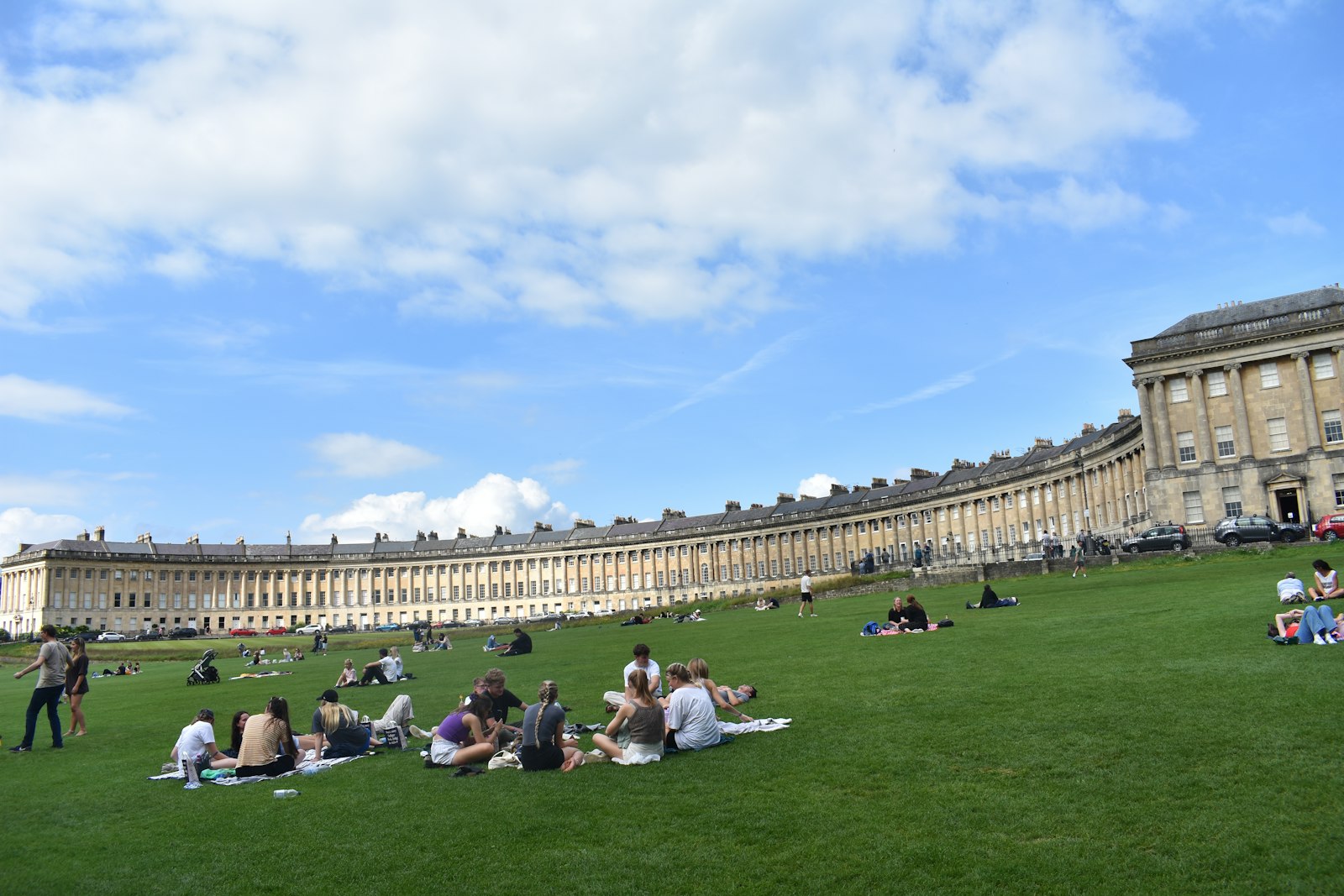
Honey-coloured crescents, colonnaded streets and candlelit ballrooms: Bath is where Bridgerton‘s Regency London comes to life, and where the real Regency still waits around every corner.
Table of Contents
Why Bath Is Bridgerton’s Real Home
Netflix’s Bridgerton is set in Mayfair, but much of its glittering London was filmed about a hundred miles west, in Bath. The reason is clear. The city was built for exactly the society the show portrays. It was a Georgian resort where the fashionable came to take the waters, dance at the Assembly Rooms, and be seen promenading along elegant streets. So much of that architecture survives intact. UNESCO inscribed the city as a World Heritage Site in 1987. In 2021 Bath was added as one of the Great Spa Towns of Europe.
For fans, that means a double pleasure: stand where the Featheringtons’ carriage pulled up, then sip tea in the Pump Room that Jane Austen knew. With four seasons now on Netflix, and Bath back on screen once more, there has never been a better moment to visit.
Bridgerton Filming Locations in Bath
No. 1 Royal Crescent: the Featherington house
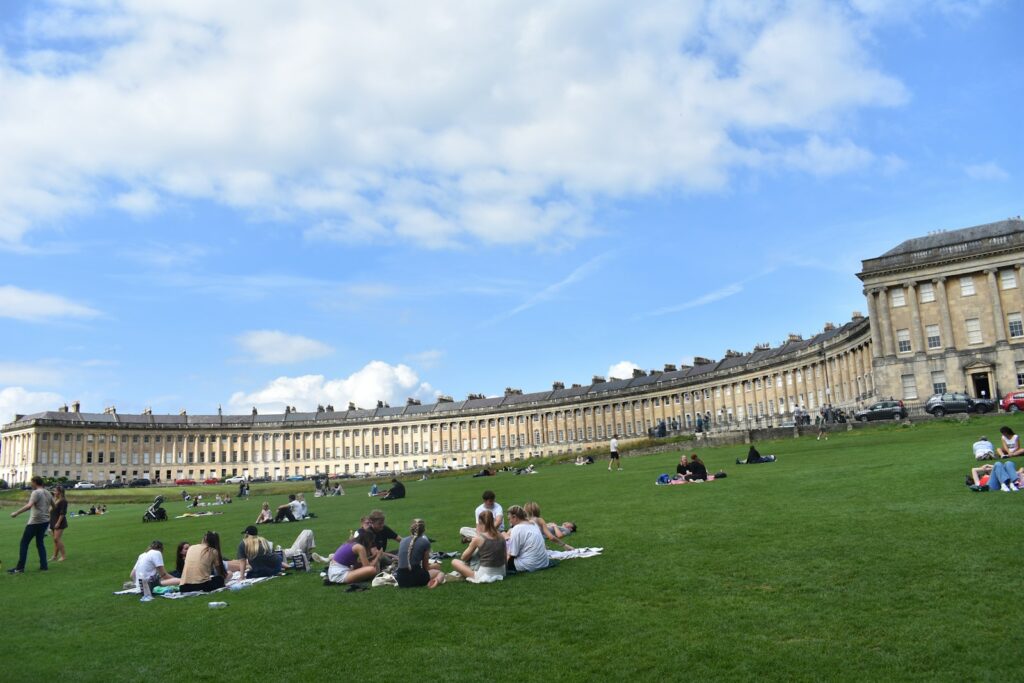
The front door and façade of No. 1 Royal Crescent play the Featheringtons’ London townhouse. For the show, the production added stone lions, pediments and rosettes to suggest the family’s showy taste, and digital effects placed the house on one side of a grand square facing the Bridgertons. The house was used again in season three. Today No. 1 is a museum run by Bath Preservation Trust, furnished as a fashionable Georgian home, with the servants’ quarters below stairs. It offers Bridgerton-themed tours showing how the house was used during filming.
The Holburne Museum: Lady Danbury’s house
At the end of Great Pulteney Street, the grand façade of the Holburne Museum is the exterior of Lady Danbury’s house, and it reprises the role in season four. Behind it is one of Bath’s finest small galleries, beside Sydney Gardens.
Abbey Green: the modiste
Tucked beside Bath Abbey, the leafy little square of Abbey Green starred in seasons one and two. The Abbey Deli became the Modiste, Madame Delacroix’s dress shop, while another corner of the square stood in for Covent Garden.
The Assembly Rooms and Guildhall: the ballrooms
The Tea Room and Ball Room of the Bath Assembly Rooms provided backdrops for ball scenes, as did the Banqueting Room of the Guildhall. The Assembly Rooms are cared for by the National Trust and are being transformed into a new Georgian visitor experience due to open in 2027. In the meantime, access is by pre-booked guided tour of the principal rooms, so check the National Trust website before you go.
The streets: Bath Street, Trim Street, Beauford Square and Edward Street
Much of the show’s street life was filmed on Bath’s cobbles. The colonnades of Bath Street, the quiet corners of Trim Street and Beauford Square, and, from season three, Edward Street off Great Pulteney Street, where crews filmed carriages, horses and costumed extras in January 2023. Many of those Edward Street scenes were shot right outside the Dukes hotel.
Tip: The film locations are compact and walkable. Start at the Royal Crescent early in the morning, before the crowds, and work downhill towards Abbey Green, Pulteney Bridge and the Holburne Museum.
To hear the behind-the-scenes stories as you go, we recommend a guided Bridgerton walking tour of Bath, which links the main sites in a couple of hours.
Affiliate-ready: Browse Bridgerton and Regency tours in Bath →
The Real Regency City
The Royal Crescent and the Circus
The Royal Crescent, a sweeping arc of 30 houses designed by John Wood the Younger and built between 1767 and 1774, is the city’s showpiece. A short walk away is the Circus, designed by his father, John Wood the Elder. Work began in 1754, and when the elder Wood died within months of the first stone being laid, his son completed it to his design.
Pulteney Bridge
Designed by Robert Adam and completed in 1774, Pulteney Bridge is one of only a handful of bridges in the world lined with shops along its full span on both sides.
The Roman Baths and the Pump Room
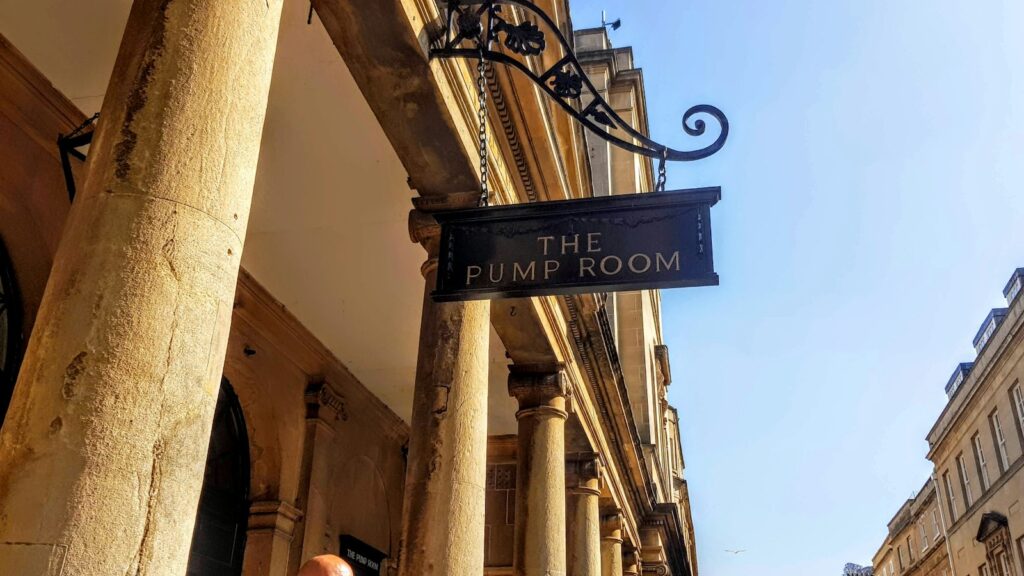
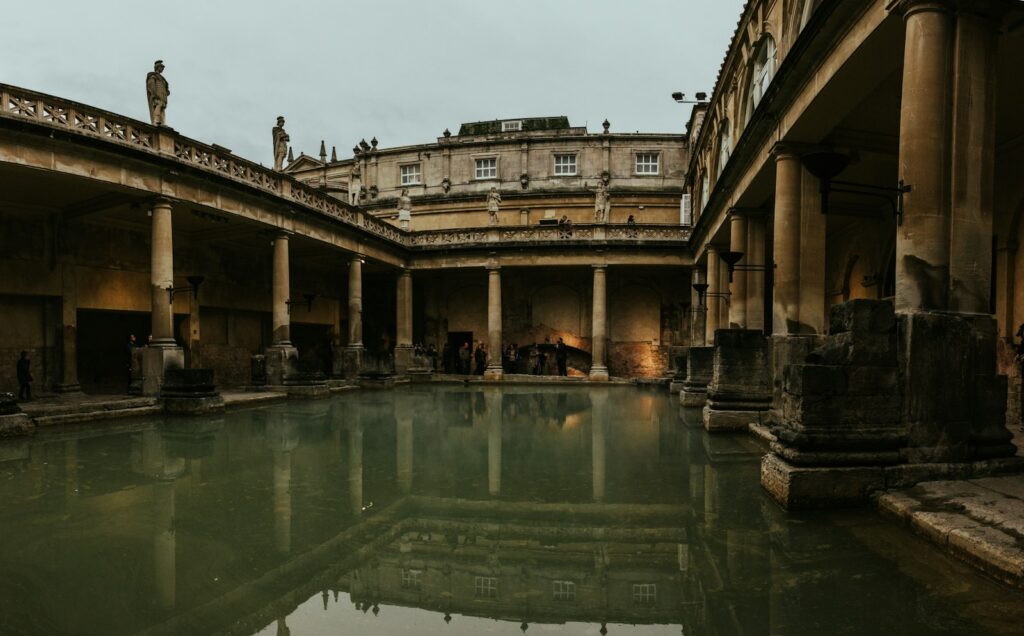
The Roman Baths are the reason Bath exists, and no visit is complete without them. Next door, the elegant Pump Room, completed in the 1790s, was the social heart of Regency Bath, where visitors gathered to drink the waters and exchange gossip. Today it is a restaurant run by Searcys, serving morning coffee and afternoon tea to live music. Pre-book a Roman Baths entry ticket or guided visit to skip the queue, then book a table in the Pump Room for afterwards.
Jane Austen’s Bath
Jane Austen lived in Bath in the early 1800s and set parts of Northanger Abbey and Persuasion here. The Jane Austen Centre at 40 Gay Street, just below the Circus, tells her story and has a Regency Tea Room upstairs. Every September the city hosts the Jane Austen Festival, ten days of talks, dances and balls opening with the Grand Regency Costumed Promenade through the streets. It usually runs in mid-September; check the official festival website for dates.
For reading on the train, we love a beautiful clothbound edition of Persuasion, Austen’s most Bath-soaked novel.
Prior Park Landscape Garden
On the hillside south of the city, Prior Park is an eighteenth-century landscape garden created by Ralph Allen, with input from the poet Alexander Pope and, possibly, Capability Brown. Now cared for by the National Trust, it has one of only four Palladian bridges of its design left in the world, with sweeping views back over the city. It is not a Bridgerton location, but it is pure Regency romance.
Thermae Bath Spa
To take the waters as the Georgians did, but with a modern twist, head to Thermae Bath Spa. Its natural thermal water fills both the indoor Minerva Bath and an open-air rooftop pool with views across the city’s rooftops and towards the surrounding hills.
Bridgerton Beyond Bath
Several of the show’s grandest houses are within easy reach, ideal for a longer trip:
- Wilton House, near Salisbury: Used for interiors of Clyvedon, the Duke of Hastings’s estate, including the dining room, and for royal rooms. Roughly an hour’s drive from Bath.
- Badminton House, Gloucestershire: Used for some Clyvedon scenes in season one and as the Danbury estate in Queen Charlotte. A private estate with limited public access.
- Castle Howard, North Yorkshire: The exterior, entrance hall and grounds of Clyvedon Castle in season one, with the nearby village of Coneysthorpe as Clyvedon village.
- Ranger’s House and the Old Royal Naval College, Greenwich: The wisteria-clad Bridgerton House and many London street scenes.
Bath also makes a natural base for the Cotswolds, where Bridgerton-style country houses and honey-stone villages abound. See our guide to the best boutique hotels in the Cotswolds if you plan to extend your stay.
Where to Stay in Bath
The Royal Crescent Hotel & Spa
For the ultimate Bridgerton address, The Royal Crescent Hotel & Spa occupies the centre of the crescent itself, a five-star hotel of 45 rooms with hidden gardens behind and a spa with an indoor pool.
The Gainsborough Bath Spa
In the heart of the old city, near the Roman Baths, The Gainsborough Bath Spa draws natural thermal water into its own Spa Village, with two thermal pools, saunas, a steam room and an ice alcove.
No.15 by GuestHouse, Great Pulteney Street
Now part of the GuestHouse group, No.15 Great Pulteney is a witty, art-filled Georgian townhouse hotel with a small spa, a short stroll from the Holburne Museum and Pulteney Bridge.
Dukes, Great Pulteney Street
Fans will love Dukes, a characterful boutique townhouse on the corner of Edward Street, where many of the season three street scenes were filmed right outside the door. Note that there is no lift.
Homewood Hotel & Spa, Freshford
For country-house calm, Homewood sits in gardens above the Avon Valley in Freshford, about 15 minutes by taxi from Bath Spa station. Expect a spa with an outdoor heated pool and hot tubs, and some rooms with private hot tubs of their own.
Affiliate-ready: Compare luxury hotels in Bath →
Practicalities
- Getting there: Direct trains run from London Paddington to Bath Spa, taking around an hour and a half. The station is a short walk from the Roman Baths and Abbey Green.
- Getting around: The compact centre is best explored on foot, though the climb to the Royal Crescent is steep.
- When to go: Spring and early summer bring long evenings; September brings the Jane Austen Festival. Book hotels well ahead for festival week.
- Booking ahead: No. 1 Royal Crescent tours, Assembly Rooms tours, Thermae Bath Spa and Pump Room afternoon tea can all sell out, so reserve in advance and check opening times before you go.
A Perfect Bridgerton Day in Bath
Morning
Begin at the Royal Crescent and tour No. 1 Royal Crescent, then stroll through the Circus to the Jane Austen Centre on Gay Street. Continue to the Assembly Rooms if you have booked a guided tour.
Afternoon
Wander down to Abbey Green for the Modiste, explore the Roman Baths, then settle in for afternoon tea in the Pump Room. Cross Pulteney Bridge and walk the length of Great Pulteney Street, past Edward Street, to the Holburne Museum and Sydney Gardens.
Evening
Watch the sun set from the rooftop pool at Thermae Bath Spa, or retreat to your hotel’s thermal pools before dinner.
FAQs
Which house is the Featheringtons’ in Bath?
No. 1 Royal Crescent, at the eastern end of the Royal Crescent. Its exterior plays the Featherington townhouse, and it is now a museum you can visit, with Bridgerton-themed tours.
Is Lady Danbury’s house in Bath?
Yes. The façade of the Holburne Museum on Great Pulteney Street plays Lady Danbury’s house, including in season four.
When is the Jane Austen Festival?
It runs for ten days each September, opening with the Grand Regency Costumed Promenade. Check the official festival website for exact dates.
Step Into Your Own Regency Season
Tell us your dates and we will design a Bath and Bridgerton itinerary with private tours, spa stays and country-house day trips.
Leave a Reply