
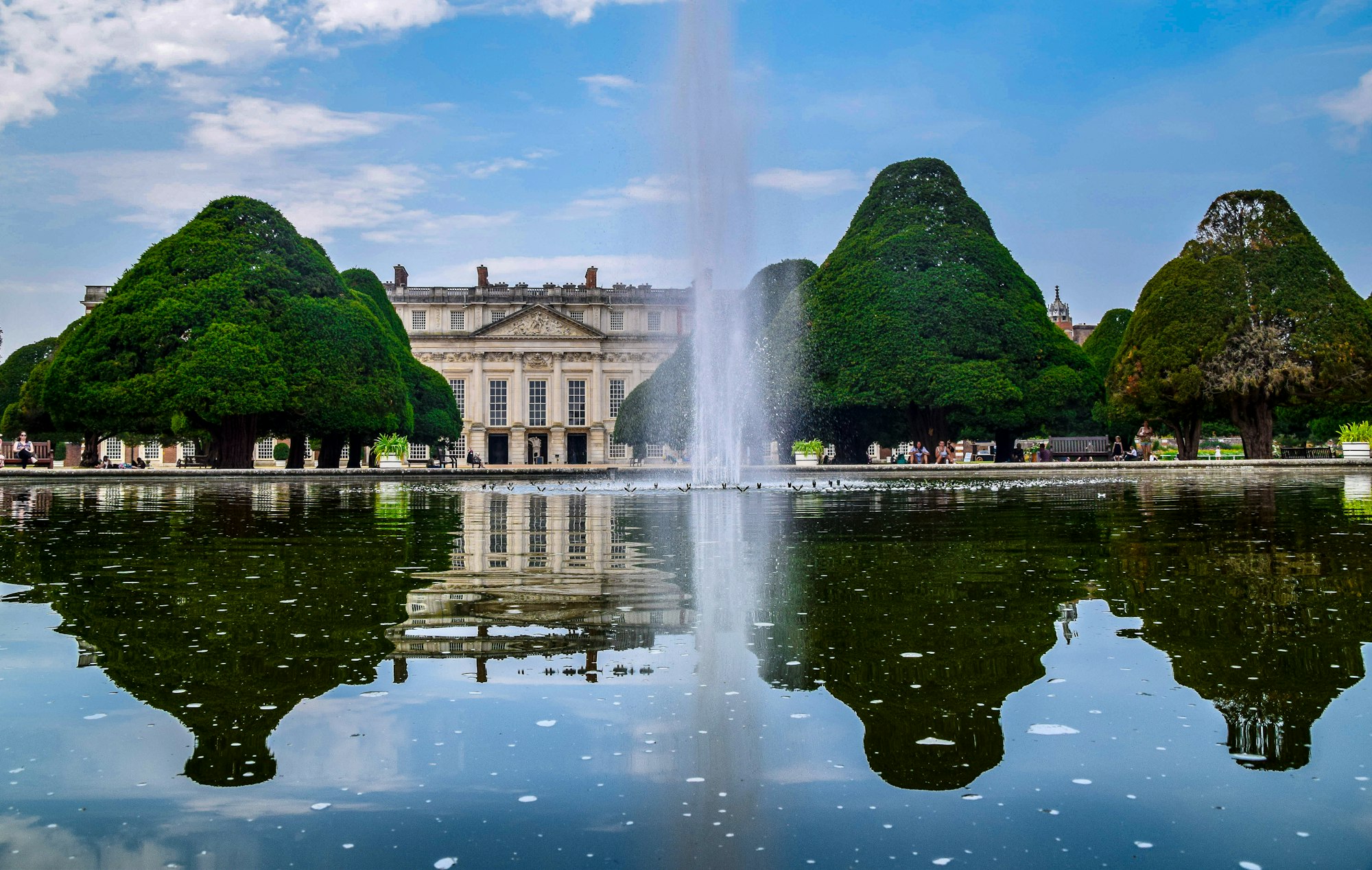
Upriver from Westminster, where the Thames runs green and slow past Surrey’s water meadows, Hampton Court Palace holds five centuries of royal ambition in one glorious sweep of Tudor brick and baroque stone.
Table of Contents
- Why Hampton Court Belongs on Every Royal Itinerary
- From Cardinal to King to Baroque Palace
- The Highlights: What Not to Miss
- The Gardens, the Great Vine and the Maze
- Annual Events at the Palace
- Getting There from London
- How Long to Allow
- Where to Stay Nearby
- Combining with Richmond and Kew
- A Perfect Hampton Court Day
- FAQs
Why Hampton Court Belongs on Every Royal Itinerary
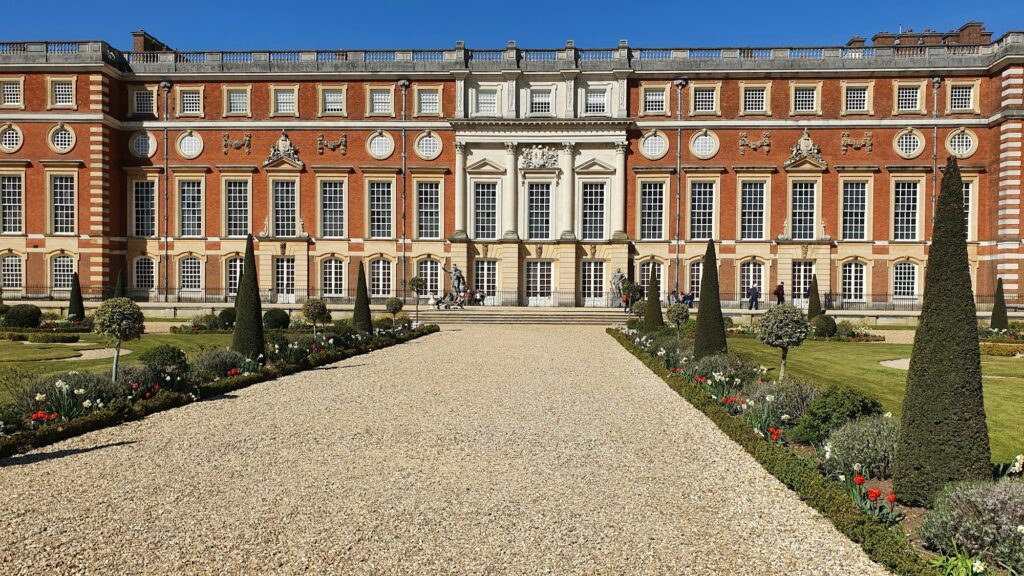
Many palaces tell one story. By contrast, Hampton Court tells two, side by side. First, walk through the gatehouse and you are in the red-brick world of Cardinal Wolsey and Henry VIII, all turrets, twisted chimneys and great courtyards. Then, keep going and the palace turns into something else entirely: the cool, symmetrical baroque state apartments built for William III and Mary II, opening onto formal gardens that run down to the river.
It is also one of the easiest grand day trips from London. A direct train from Waterloo takes under 40 minutes, and the palace sits just across the bridge from the station. On our Royal & Castle Britain trail, it is the essential Tudor chapter.
From Cardinal to King to Baroque Palace
Wolsey’s palace
The story begins with Thomas Wolsey, Henry VIII’s chief minister, who took on the manor at Hampton in the mid-1510s and transformed it into a palace fit to entertain kings and ambassadors. It was almost too magnificent. As Wolsey fell from favour at the end of the 1520s, the palace passed to Henry, who made it one of his favourite residences.
Henry VIII’s river palace
Henry spent lavishly. He built the vast kitchens, the Great Hall and the Chapel Royal’s extraordinary ceiling, and the palace saw some of the most dramatic moments of his reign: honeymoons, the birth of his longed-for son Edward, the death of Jane Seymour, and the arrest of Catherine Howard.
Wren, William and Mary
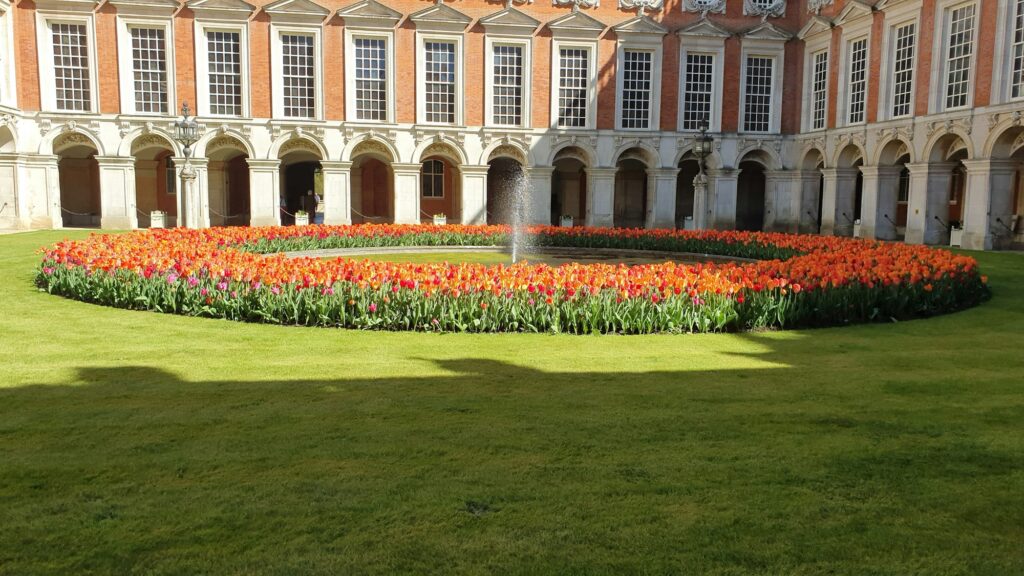
After William III and Mary II came to the throne in 1689, they commissioned Sir Christopher Wren to rebuild the palace in the latest baroque style. Ambitions were scaled back and much of the Tudor palace survived, but Wren’s new royal apartments around Fountain Court, with their elegant South and East Fronts, gave Hampton Court its second, very different face. Today the palace is cared for by Historic Royal Palaces, the independent charity that also looks after the Tower of London and Kensington Palace.
The Highlights: What Not to Miss
The Great Hall
Henry’s Great Hall, built in the 1530s, is the theatrical heart of the Tudor palace. Look up at the carved hammerbeam roof, where tiny painted heads known as the “eavesdroppers” peer down, and look for traces of Anne Boleyn’s arms, carved during her brief reign. The walls are hung with sixteenth-century tapestries telling the story of Abraham, woven for Henry and as rich in colour as they are in symbolism.
The Tudor Kitchens
Henry’s kitchens were built to feed a court that could number around a thousand people, and they survive on a remarkable scale. Wander through the boiling house, the great fireplaces and the serving places, and on selected days you may find costumed cooks recreating Tudor recipes. It is the moment the palace comes alive for children and adults alike.
The Haunted Gallery and the Catherine Howard legend
Few corridors in England carry a better story. Catherine Howard, Henry’s fifth wife, was confined at Hampton Court in 1541 before her execution the following year. Legend says she broke free from her guards and ran down this gallery, screaming for the king, and that her ghost still repeats the dash. Historians doubt the tale, but it is cherished palace lore, and the gallery is wonderfully atmospheric on a grey afternoon.
The Chapel Royal
Still a working chapel after nearly five hundred years, the Chapel Royal is crowned by Henry’s dazzling vaulted ceiling of deep blue and gold, studded with stars and carved pendants. If you can, attend a service: it is a wonderfully atmospheric way to experience the palace.
Tip: Arrive at opening time and head straight for the Tudor Kitchens and Great Hall, then save the gardens for the afternoon when the light is softer and the morning crowds have moved on.
The Gardens, the Great Vine and the Maze
The palace sits in around 60 acres of formal gardens beside the Thames, and they deserve almost as much time as the interiors.
- The Privy Garden: William III’s private garden, reconstructed in 1995 to its early eighteenth-century design, with clipped yews, formal parterres laid out between the palace and the river.
- The Great Vine: Planted in 1768 when Lancelot “Capability” Brown was head gardener, it is widely recognised as the largest grapevine in the world. Its black grapes are harvested each year and traditionally sold in the palace shop in early autumn.
- The Maze: Planted for William III around 1690, it is the oldest surviving hedge maze in Britain.
- The Magic Garden: An imaginative play garden in Henry VIII’s former Tiltyard, guarded by a great sleeping dragon and full of towers, battlements and hidden corners. Opening is seasonal, so check before you go if you are travelling with children.
For skip-the-line entry, consider pre-booked Hampton Court Palace entrance tickets, or let an expert bring the Tudors to life on a guided Hampton Court tour from London.
Annual Events at the Palace
Hampton Court Palace Festival
Each June, the palace’s Base Court becomes an open-air concert venue for the Hampton Court Palace Festival, with picnics in the gardens before the music. The festival runs over selected nights each June; check the line-up and book early. The best tickets go quickly once the next line-up is announced.
RHS Hampton Court Palace Garden Festival
The Royal Horticultural Society’s summer show in the palace grounds, formerly known as the Hampton Court Palace Flower Show, has moved to a biennial schedule. It is traditionally held in early July; check the RHS website for the next date and book early.
Christmas at the palace
In winter, Hampton Court puts on festive programming and an outdoor ice rink. At Christmas the palace usually stages a festive season; check dates and timed tickets before travelling.
Getting There from London
By train
South Western Railway runs direct trains from London Waterloo to Hampton Court, the end of the line, in around 35 to 40 minutes. From the station, simply cross the bridge over the Thames and the palace gates are a few minutes’ walk away.
By river
For a leisurely, quintessentially English approach, seasonal boats run upriver from Westminster Pier via Kew and Richmond to Hampton Court, typically from spring to the end of October. The full trip takes several hours and sailing times vary with the tides, so many visitors take the boat one way and the train back. Services do not usually run from Westminster in winter, so check the operator’s timetable before you plan around it. You can also book a Thames river cruise to see more of the royal river.
Affiliate-ready: Browse Hampton Court Palace tickets, tours and day trips →
How Long to Allow
Allow a full day. Three to four hours covers the Tudor and baroque interiors at a good pace, and the gardens, maze and vine easily take another two. With lunch, five to six hours is ideal. Opening hours are shorter in winter, when last admission is in mid-afternoon, so arrive early if you are visiting between November and March.
Where to Stay Nearby
Inside the palace: the Landmark Trust
For a truly once-in-a-lifetime stay, the Landmark Trust lets two historic apartments within the palace itself. The Georgian House, built in 1719 as kitchens for George, Prince of Wales, sleeps up to eight and has its own walled garden, while Fish Court occupies former Tudor service quarters. Both book up far in advance, directly with the Landmark Trust.
The Mitre, Hampton Court
Directly across the road from the palace on the riverbank, The Mitre is a characterful boutique hotel with eclectic, colourful interiors, a riverside terrace and a restaurant overlooking the Thames. It is the natural choice if you want to be first through the palace gates in the morning.
The Petersham, Richmond
A short drive downriver, The Petersham sits high on Richmond Hill with famous views over the Thames meadows, a fine base for combining Hampton Court with Richmond Park and Kew.
Affiliate-ready: Compare hotels around Hampton Court and Richmond →
Combining with Richmond and Kew
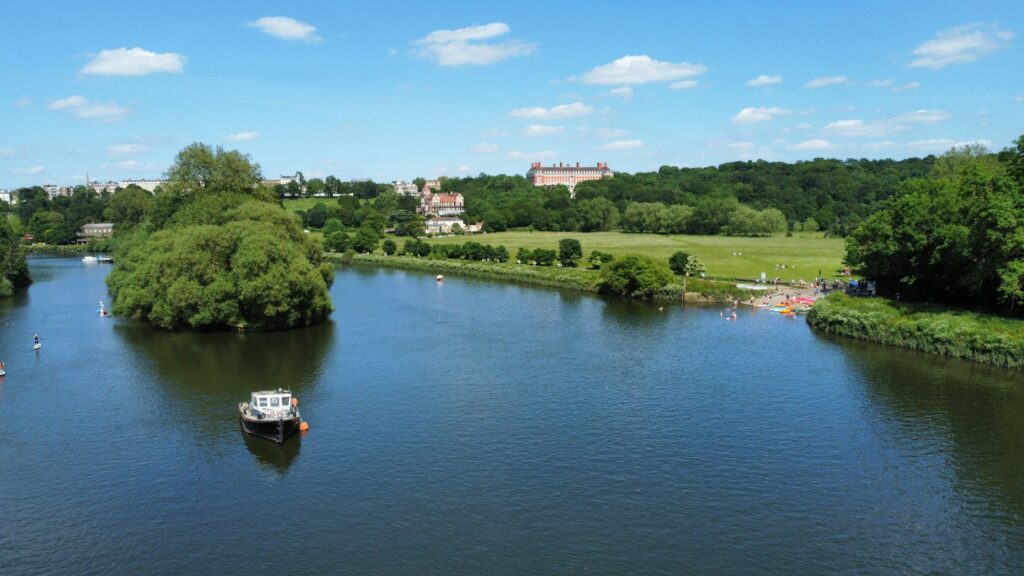
Hampton Court sits at the top of a remarkable stretch of royal river. Richmond offers riverside walks, Richmond Park’s deer herds and the view from Richmond Hill, while Kew has the Royal Botanic Gardens and little Kew Palace, also cared for by Historic Royal Palaces. Both lie on the river boat route, making a two-day “royal Thames” itinerary easy. Pre-book Kew Gardens tickets to save time at the gate.
A Perfect Hampton Court Day
- Morning: Take an early train from Waterloo and be at the gates for opening. Start in the Tudor Kitchens and Great Hall, then the Chapel Royal and the Haunted Gallery.
- Midday: Lunch at the palace café or across the bridge in East Molesey, then the baroque state apartments.
- Afternoon: The Privy Garden, the Great Vine and the Maze, with a riverside walk along the Thames.
- Evening: Stay for dinner at The Mitre, or head back into town for something special from our guide to Michelin-starred dining in London.
FAQs
How do I get to Hampton Court Palace from central London?
The easiest way is the direct South Western Railway train from London Waterloo to Hampton Court station, around 35 to 40 minutes, then a short walk across the bridge. In season, river boats also run from Westminster.
Who runs Hampton Court Palace?
Historic Royal Palaces, an independent charity that also cares for the Tower of London, Kensington Palace, the Banqueting House and Kew Palace.
Is the Haunted Gallery really haunted?
The tale of Catherine Howard’s ghost is a much-loved legend, not established fact. Historians doubt the story, but the gallery remains one of the palace’s most atmospheric spaces.
Is the RHS flower show at Hampton Court every year?
Not any more. The RHS Hampton Court Palace Garden Festival now runs every other year and is expected to return in 2027. Check the RHS website for confirmed dates.
Plan Your Royal Thames Escape
Tell us your dates and we will design a seamless royal itinerary, from palace stays and private guides to riverside hotels and memorable dinners.
Leave a Reply